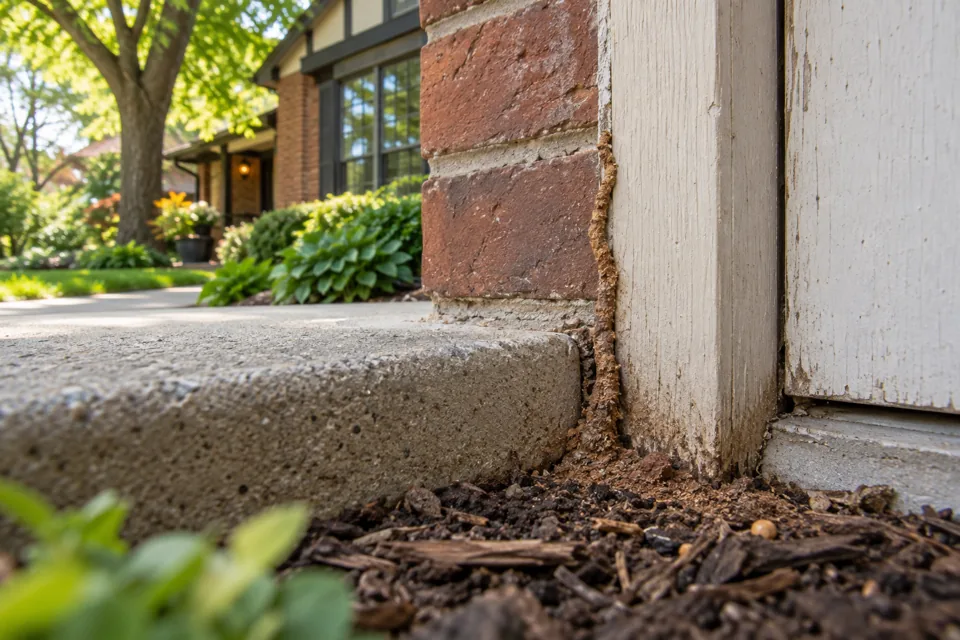
A subterranean colony lives in the soil and reaches wood through mud tubes; a drywood colony lives inside the wood itself; and the method differs for each. If you have found mud tubes, discarded wings or pinhole-sized frass, say so when you use Call Now, and you will be connected with an independent provider serving the Madison area.
Signs of termites in a house
- Mud tubes: pencil-width tunnels of soil on foundation walls, piers or sill plates
- Frass: tiny six-sided wood pellets from drywood termites, kicked out of small holes
- Bubbling or buckling paint, warped doors and windows that suddenly stick, and soft spots in baseboards
- Hollow-sounding or sagging wood that sounds papery when tapped with a screwdriver handle
- Swarmers: winged termites near windows and lights, usually in spring, and piles of shed wings
What a termite inspection should cover
The inspector checks the foundation perimeter, crawl space or garage slab edges, attic framing, window and door frames, decks, fence posts that touch the house, and any wood in contact with soil. Tools are a flashlight, a moisture meter and a probe.
A lender may ask for a wood-destroying insect report as part of a home sale. It lists what was seen and anything that could not be accessed. Do not read it as a guarantee for the future.
What happens after treatment
Treated soil and bait stations work over weeks, not hours, and mud tubes may stay visible even when termites are gone. The provider should tell you what to watch for, when the next inspection will be, and what the written guarantee does and does not cover.
Leave any active mud tubes untouched until the inspection, and take photos of them in place.
Termite treatment methods compared
| Method | How it works | Typical use |
|---|---|---|
| Liquid termiticide (soil trench and rod) | A treated zone in the soil around the foundation stops termites from reaching the structure | Subterranean termites around slab and crawl space foundations |
| Moisture and wood-to-soil fixes | Removing wood contact, repairing leaks and improving drainage | Every case, because it removes what termites need |
| Spot and localized wood treatment | Foam, dust or injected product placed into the infested wood | Small drywood infestations in accessible wood |
| Structural fumigation (tenting) | A gas fills the whole structure for a set time while the home is vacated | Widespread drywood termites in several areas of the house |
| Bait stations | Stations in the ground hold a slow-acting bait that workers carry back to the colony | Subterranean termites when soil treatment is hard, or alongside it |
Subterranean, drywood and Formosan termites
Three kinds of termite matter most. Subterranean termites live in the soil, need moisture and build mud tubes to reach wood above ground; nationally they do the most structural damage of any wood-destroying insect. Drywood termites come in through attic vents, eaves and cracks and stay inside dry wood, where they leave frass. Formosan termites, an aggressive subterranean species in Gulf and southeastern states, form very large colonies.
If a provider identifies the termite and shows you the places where it is feeding, the first job has been done properly. Any treatment decided ahead of the identification amounts to a guess.
Questions to ask before you agree to any termite inspection and control
- What will you seal, remove or fix, and what stays my job?
- How many visits are in the plan, and what happens if activity returns?
- Which products, baits or devices will you use, and where will they go?
- Who is on site, and can you show the state licence or applicator ID for the work?
- What will you write down for me: scope, exclusions, follow-up and product list?
How a termite inspection and control visit works, step by step
Pest visits that are done properly run in a fixed order, no matter which insect or animal is involved. Keep that order in mind when you talk to different companies, because a visit that leaves out the opening steps is the one to question.
- Inspection: the technician walks the outside first (foundation, vents, utility lines, eaves, fence lines, mulch) and then the inside (kitchen, bathrooms, garage, attic or crawl space).
- Identification: the species is named from the insect, droppings, damage or trail, because the right product and method depend on it.
- Plan: the provider explains what will be done, which products or devices will be used, and what you need to do before and after.
- Treatment or exclusion: the work is done in the places the inspection found, not by spraying every room.
- Follow-up: you get a date for the next check and a clear answer on what to report if activity returns.
What makes termite inspection and control different in Madison
Madison sits on an isthmus between Lake Mendota and Lake Monona, so water, marsh edges and shoreline vegetation shape the mosquito and insect season. The University of Wisconsin campus and the large rental market mean frequent turnover, which raises the risk of bed bugs and cockroach spread in multi-unit buildings.
Cold winters push mice and overwintering insects into homes, garages and attics from fall. Older neighborhoods have mature trees and wood features that suit carpenter ants when moisture is present. Ask any provider how these local details change the plan for your address, because a method that works in one climate or housing style can fail in another.
Termite inspection and control across Madison and nearby cities
In Madison, Wisconsin, Pest Control in Madison serves ZIP codes: . Providers working in Middleton, Fitchburg, Sun Prairie, Verona and Monona also receive calls and requests. Each address is checked individually, which is why it helps to give your ZIP code on the call.
To get going, press Call Now at the top of any page and tell the person who answers what you found. That puts you through to an independent provider nearby, and the provider verifies your address, looks the property over and writes up the scope.
Related help in Madison
If this is not quite your situation, these pages cover the neighboring questions: Signs and inspection: pest control; Pest inspection; Ant control; Spider control. The service area list shows every nearby city and ZIP code covered.